
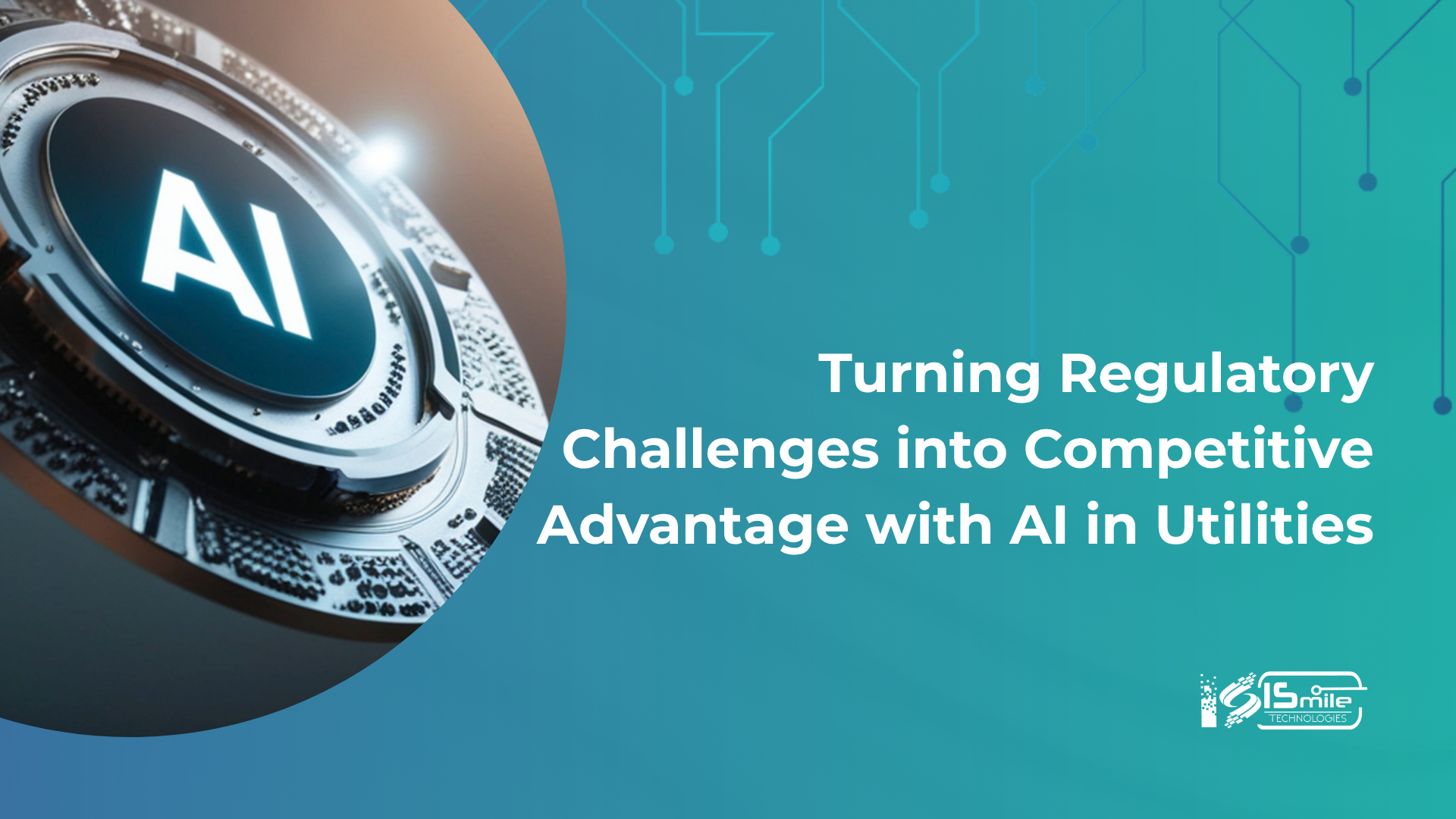

From Regulatory Complexity to Strategic Intelligence
Utilities are navigating an increasingly complex regulatory landscape where agility, transparency, and real-time insights are becoming critical to operational success.
Regulations are no longer static frameworks—they evolve alongside technology, sustainability mandates, and grid modernization efforts. For utilities, this creates a dual challenge: maintaining compliance while continuing to innovate and scale operations.
The opportunity, however, lies beyond compliance.
Forward-looking organizations are transforming regulatory requirements into a source of intelligence—leveraging AI to enhance decision-making, strengthen governance, and build more resilient operations.
The Challenge: Scaling Operations in a Regulated Environment
Utilities today operate at the intersection of infrastructure complexity, regulatory oversight, and rising customer expectations.
Despite significant investments in digital systems, many organizations still face:
- Fragmented data across compliance, operations, and risk systems
- Limited visibility into enterprise-wide regulatory alignment
- Reactive processes that delay decision-making
- Disconnected governance frameworks
This results in inefficiencies that impact not just compliance, but overall operational performance.
The real challenge is not regulation itself—it’s the inability to convert regulatory data into actionable intelligence.
The Shift: From Compliance Obligation to Intelligent Operations
A new approach is emerging—one that redefines compliance as part of a broader, AI-enabled operating model.
This shift is characterized by:
- Moving from static reporting to continuous regulatory readiness
- Replacing siloed processes with connected data ecosystems
- Enabling proactive decision-making through AI-driven insights
- Embedding governance into everyday operational workflows
In this model, compliance becomes a natural outcome of intelligent operations—not a separate, reactive function.
From Compliance to Decision Intelligence
At the core of this transformation is the evolution from manual oversight to AI-assisted decision systems.
What Changes?
Traditional Approach
- Periodic reviews and reporting cycles
- Manual validation and reconciliation
- Delayed identification of risks
AI-Enabled Approach
- Continuous visibility across operations and regulatory requirements
- Data-driven insights guiding decisions
- Early identification of potential risks and gaps
This shift enables utilities to operate with greater confidence, speed, and strategic alignment.
AI + Governance + Risk Management Framework
To support this transformation, utilities must adopt an integrated approach that combines AI with governance and risk management.
Key Components
Unified Data Ecosystem
A connected data foundation that brings together operational, regulatory, and enterprise data into a single source of truth.
Intelligent Monitoring Systems
AI models that analyze patterns, identify anomalies, and provide insights for proactive action.
Integrated Governance Layer
Policies, controls, and compliance requirements embedded into workflows and systems.
Decision Intelligence Framework
AI-driven insights that support leadership decisions across operations, risk, and compliance functions.
This approach ensures that regulatory alignment is continuous, scalable, and embedded across the enterprise.
AI + IoT + Data: Enabling Regulatory Visibility
Modern utilities are increasingly leveraging connected technologies to enhance operational awareness.
By combining:
- IoT-enabled asset data
- Advanced analytics platforms
- AI-driven insights
Organizations can achieve:
- End-to-end visibility across infrastructure and operations
- Better alignment between field activities and regulatory expectations
- Improved accuracy in reporting and compliance monitoring
This creates a foundation for intelligent, data-driven regulatory readiness.
Role of Responsible AI in Regulated Industries
As AI becomes central to operations, responsible deployment is critical—especially in highly regulated environments.
Key considerations include:
- Transparency in AI-driven decisions
- Data governance to ensure accuracy and consistency
- Security and compliance aligned with regulatory standards
- Explainability to support audit and review processes
Responsible AI is not just a technical requirement—it is essential for building trust with regulators, stakeholders, and customers.
How ISmile Technologies Enables AI-Driven Regulatory Intelligence in Utilities
ISmile Technologies brings a practical, enterprise-focused approach to transforming regulatory operations through AI.
Our Approach
1. Unified AI and Data Ecosystem
We design and implement cloud-native architectures on Microsoft Azure that integrate data, analytics, and AI into a cohesive platform.
2. Enterprise System Integration
Seamless connectivity across operational systems, governance frameworks, and enterprise applications ensures consistent data flow and visibility.
3. AI-Driven Decision Enablement
We enable intelligent systems that provide contextual insights, helping organizations make faster and more informed decisions.
4. Scalable Implementation Model
Our approach supports gradual adoption—starting with high-impact use cases and expanding across the enterprise.
5. Secure and Compliant Deployment
We ensure that all solutions align with enterprise-grade security, governance, and regulatory requirements.
Implementation Strategy: From Vision to Execution
A successful transformation requires a structured yet flexible approach:
Establish a Data Foundation
Unify enterprise data across operations, compliance, and risk domains.
Identify High-Impact Opportunities
Focus on areas where AI can deliver immediate value in improving visibility and decision-making.
Integrate AI into Workflows
Embed intelligence into existing systems and processes without disrupting operations.
Scale Across the Enterprise
Expand capabilities to additional functions, creating a connected and intelligent ecosystem.
Business Outcomes: Beyond Compliance
Utilities adopting AI-driven regulatory intelligence can achieve:
- Improved operational efficiency and performance
- Faster audit readiness and reporting cycles
- Enhanced accuracy in compliance monitoring
- Reduced operational risk and regulatory exposure
- Greater transparency across enterprise operations
More importantly, they gain the ability to use regulatory data as a strategic asset—driving better planning, forecasting, and decision-making.
From Reactive Interactions to Predictive Engagement
Regulatory processes are no longer isolated functions—they are part of a broader enterprise intelligence system.
By leveraging AI:
- Organizations can anticipate risks rather than react to them
- Decisions are informed by real-time insights and historical patterns
- Compliance becomes integrated into daily operations
This creates a shift from reactive management to predictive, intelligence-driven engagement.
Human + AI Collaboration in Enterprise Operations
AI does not replace human expertise—it enhances it.
In this model:
- AI handles data processing, pattern recognition, and insight generation
- Leaders focus on strategic decisions and complex problem-solving
- Teams operate with greater clarity, confidence, and efficiency
This collaboration enables a more agile and resilient organization.
Conclusion
Regulatory complexity is no longer just a challenge—it is an opportunity to build smarter, more resilient operations.
By adopting AI-driven regulatory intelligence, utilities can transform compliance from a reactive obligation into a strategic capability that drives enterprise value.
The future of utilities lies in transforming regulatory complexity into a source of intelligence—where AI enables organizations to operate with greater transparency, resilience, and strategic advantage.
FAQs
1. What is AI-driven regulatory intelligence?
It is the use of AI and data platforms to enhance visibility, decision-making, and governance across regulatory and operational processes.
2. How does AI improve regulatory readiness?
By providing continuous insights, improving data accuracy, and enabling proactive alignment with regulatory requirements.
3. Is this approach suitable for highly regulated industries?
Yes, when implemented with strong governance, security, and compliance frameworks.
4. What role does Azure play in this transformation?
Azure provides a scalable, secure foundation for integrating data, AI, and enterprise systems.
5. How can utilities get started?
By building a unified data foundation, identifying high-impact opportunities, and partnering with experts like ISmile Technologies to implement AI-driven solutions.


 English
 Indian English