
Innovation for the
Utility Industry

Modernize Where
It Matters

Empower Your
Field Employees\

Improve End User
Experiences
Build Towards a Sustainable Grid
Seamlessly connect energy production, delivery, and everything in between, with
best-of-class energy software and strategies.

Advanced, AI-driven analytics for load
balancing & forecasting
Plan for demand: real-time, intelligent energy
analytics software empowers smarter load
forecasting. Use historical and current data to
know what’s coming, stay ahead of failure,
optimize efficiencies and reduce energy
waste/cost.

Intelligent asset maintenance and
capacity management
Unlock new insights into the planning,
investment, generation, storage, transmission,
delivery and maintenance of energy
resources. Plus, maintain equipment before it
fails, using predictive analytics.

Connected, optimized energy
delivery at the right time
Leverage AMI data to understand unique
customer usage patterns, respond with
meaningful time of use plans, and drive
demand response programs to shave load
curve, while enhancing customer
experiences.
A VISION FOR WORKING IN THE FUTURE
The energy space is rapidly transforming — and so is the technology behind its workers. Safety, security and
reliability are in focus.
Empower utility field workers
Technology can ensure field workers are given the right resources at the right time. Their routes will be scheduled, and optimized, with the latest job orders, call center reports, system health statuses and AI generated pre-visit summaries which gives you situational awareness prior to getting to the worksite. Best of all, they’ll have the right equipment for the job with them — reducing the need for repeat visits to sites.
Employ drones and robotics to remote sites
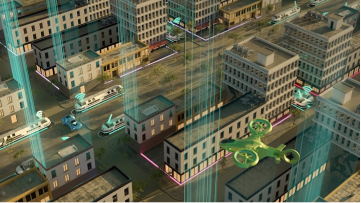
Intelligent drones and other robotics will be online and at work
augmenting the human workforce with much-needed support from specialized machinery. Equipment can be delivered aerially, for example. Or, dangerous scenarios can be navigated safely and without risk of injury.
Enhance reality with advanced AI copilots
Digital assistants, advanced AI copilots and the latest in energy software will create new, critical integration points between human workers in the field and the rest of the business. These “mixed- reality” devices will be commonplace, overlaying reality with holographic visuals to supplement repairs.

Transform the utility customer Services experiences
The energy space is rapidly transforming — and so is the technology behind its workers. Safety, security and
reliability are in focus.
“[Before Ismile technologies], we had a fragmented architecture with lots of data silos. This led to 50 percent longer lead times before data was available to business partners and internal developers, leading to complex pipelines that limited data visibility and difficulties getting insights reliably.”
Ghouse Khan
IT Manager
Company
FACE DISTRUPTION WITH CONFIDENCE
Nothing is constant but change. It’s hard to predict what’s coming, but we are prepared to help utility organizations with the data management, cloud infrastructure, energy
software and advanced analytics.
Prepare for increased,
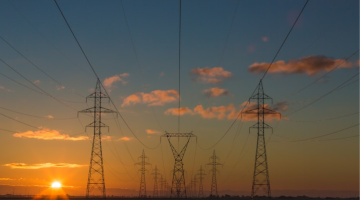
global energy demand
By 2050, total world energy demand is expected to grow by more than 20%. As more and more countries industrialize, the energy demands are only growing, an impetus for better sustainability.
Measure the impact of electric vehicle adoption
With EV usage and the adoption of home chargers exploding, utility companies are looking for new ways to detect individual usage patterns behind the meter.
Navigate new, decentralized
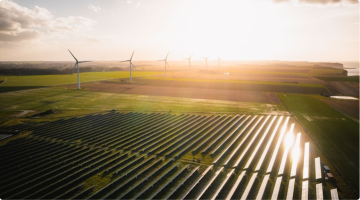
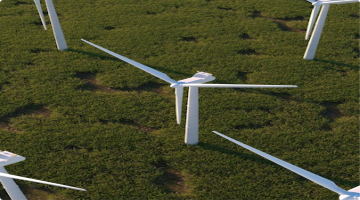
renewable energy sources
A move towards sustainability means
navigating from traditional to distributed energy (DER) sources to decentralized options such as wind and solar. What was once “one way” and linear is now a complex web of two-way energy flow.

Create responsible & informed customers
Today’s utility customers expect
transparency – they want to understand their personal energy consumption and are willing to change their behavior to save
money and positively impact the
environment.

Stay ahead of smart and connected homes and appliances
New smart grid analytics allow for
disaggregation of AMI data to let you gain insight into how and why your customers are using energy – down to the granularity of a teakettle.
Efficiently respond to demanding regulatory environments
In a increasingly regulated space, with a massive number of documents, legal filings at play — Gen AI and other emerging technologies can provide competitive advantage.
We’re experts when it comes to helping our customers deploy the newest, AI-enhanced cloud and data tech for companies in the utilities space. All with the latest in governance and security standards built in.
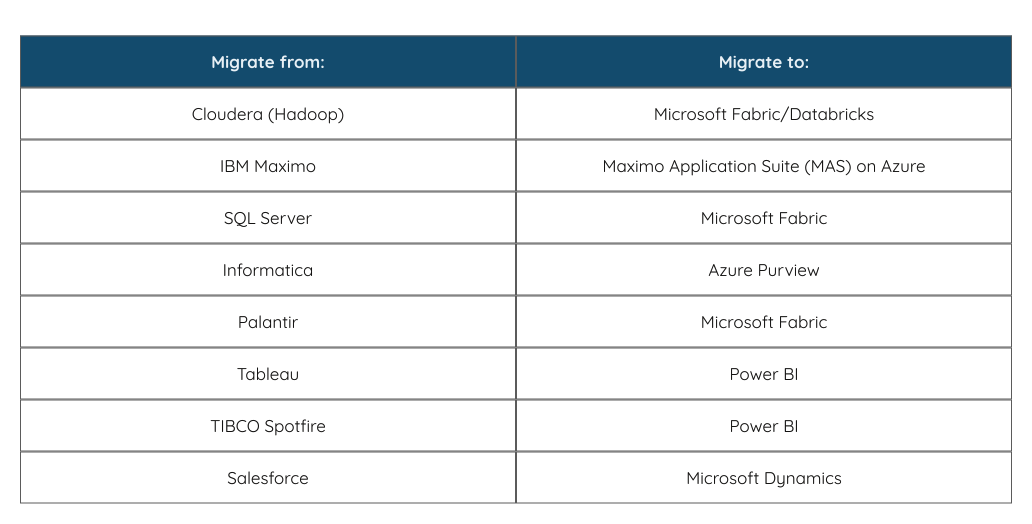
Leverage the energy software and tools you need to bring positive change to your organization.
We offer several ready-made, AI- driven offerings that can be deployed in days.
Nothing is constant but change. It’s hard to predict what’s coming, but we are prepared to help utility organizations with the data management, cloud infrastructure, energy
software and advanced analytics.

Utility firms can drive transformational outcomes: these high-value use cases demonstrate a path forward.
Use this report to empower your teams and
inform your strategies to drive long-term
growth and resilience.
Three utility thought leaders have come
together to share their thoughts on the role of technology in energy transformation.
Digital transformation in utilities involves adopting AI, cloud computing, IoT, automation, and data analytics to modernize operations, improve grid performance, enhance customer experiences, and support sustainability initiatives.
AI optimizes energy generation, forecasts demand, minimizes waste, automates operations, improves asset utilization, and identifies inefficiencies that reduce operational and maintenance costs.
Smart grids are modern electricity networks that use digital communication, sensors, AI, and automation to monitor, manage, and optimize electricity generation, transmission, distribution, and consumption in real time.
Predictive analytics helps utilities forecast equipment failures, energy demand, weather impacts, maintenance schedules, and customer consumption trends, enabling proactive operational decisions.
Customers benefit from accurate billing, personalized energy insights, faster outage restoration, proactive notifications, self-service support, and better overall service experiences.
Utilities improve grid reliability through predictive maintenance, AI-driven monitoring, automated fault detection, real-time analytics, renewable energy optimization, and advanced distribution management systems.
AI-powered utility solutions use artificial intelligence, machine learning, predictive analytics, and automation to improve grid reliability, optimize energy distribution, reduce outages, enhance asset maintenance, and deliver better customer experiences. ISmile Technologies helps utility organizations modernize operations with scalable AI-driven solutions.
AI improves smart grid management by analyzing real-time energy data, forecasting demand, balancing electrical loads, detecting anomalies, predicting equipment failures, and automating operational decisions. This helps utilities improve reliability while lowering operational costs.
Predictive maintenance uses AI, IoT sensors, and historical equipment data to predict failures before they occur. Utilities can schedule maintenance proactively, reduce unexpected outages, extend asset lifespan, and lower maintenance costs.
AI continuously monitors grid performance, identifies abnormal behavior, predicts equipment failures, and recommends preventive actions. Combined with smart sensors and advanced analytics, utilities can reduce outage frequency and restore power faster.
Advanced Metering Infrastructure (AMI) is a smart metering system that enables two-way communication between utilities and customers. It provides real-time consumption data, remote meter management, outage detection, accurate billing, and demand response capabilities.
AI analyzes weather patterns, historical consumption, seasonal trends, economic factors, and real-time grid data to accurately forecast future energy demand. Better forecasting helps utilities optimize generation and reduce energy waste.
Digital transformation enables utilities to improve operational efficiency, modernize aging infrastructure, increase grid resilience, enhance cybersecurity, automate workflows, improve customer engagement, and support renewable energy integration.
AI copilots provide technicians with work orders, equipment history, repair recommendations, safety guidelines, optimized routes, and AI-generated summaries before arriving at job sites, improving productivity and reducing repeat visits.
Cloud platforms centralize utility data, improve collaboration, enable real-time analytics, strengthen disaster recovery, support AI applications, and reduce infrastructure costs while providing greater scalability and security
Utility organizations often store information across multiple systems. Integrating operational, customer, meter, GIS, and asset data creates a unified view that improves decision-making, operational efficiency, and AI model accuracy.
AI-powered chatbots, personalized energy recommendations, outage notifications, self-service portals, and predictive customer support improve engagement while reducing support costs and response times.
AI predicts renewable energy generation from solar and wind sources, balances fluctuating supply and demand, optimizes battery storage, and helps utilities maintain grid stability with distributed energy resources.
Utility companies should implement Zero Trust security, identity management, endpoint protection, continuous monitoring, threat detection, network segmentation, compliance management, and AI-powered security analytics to protect critical infrastructure.
Generative AI automates document creation, regulatory reporting, customer communications, legal documentation, outage response summaries, knowledge management, and employee support while improving productivity across utility operations.
AI continuously evaluates equipment health, predicts replacement schedules, prioritizes maintenance activities, and helps utilities maximize asset utilization while reducing operational costs.
Demand response programs encourage customers to reduce or shift electricity usage during peak demand periods. AI identifies usage patterns and automatically recommends the most effective demand response strategies.
Investing in AI enables utilities to reduce operational costs, improve reliability, strengthen cybersecurity, modernize infrastructure, support renewable energy, increase customer satisfaction, and prepare for future energy demands.
Didn’t find the answer you’re looking for?
Help us improve our knowledge base by submitting a question and suggested answer.
Our team will review your submission before publishing.