
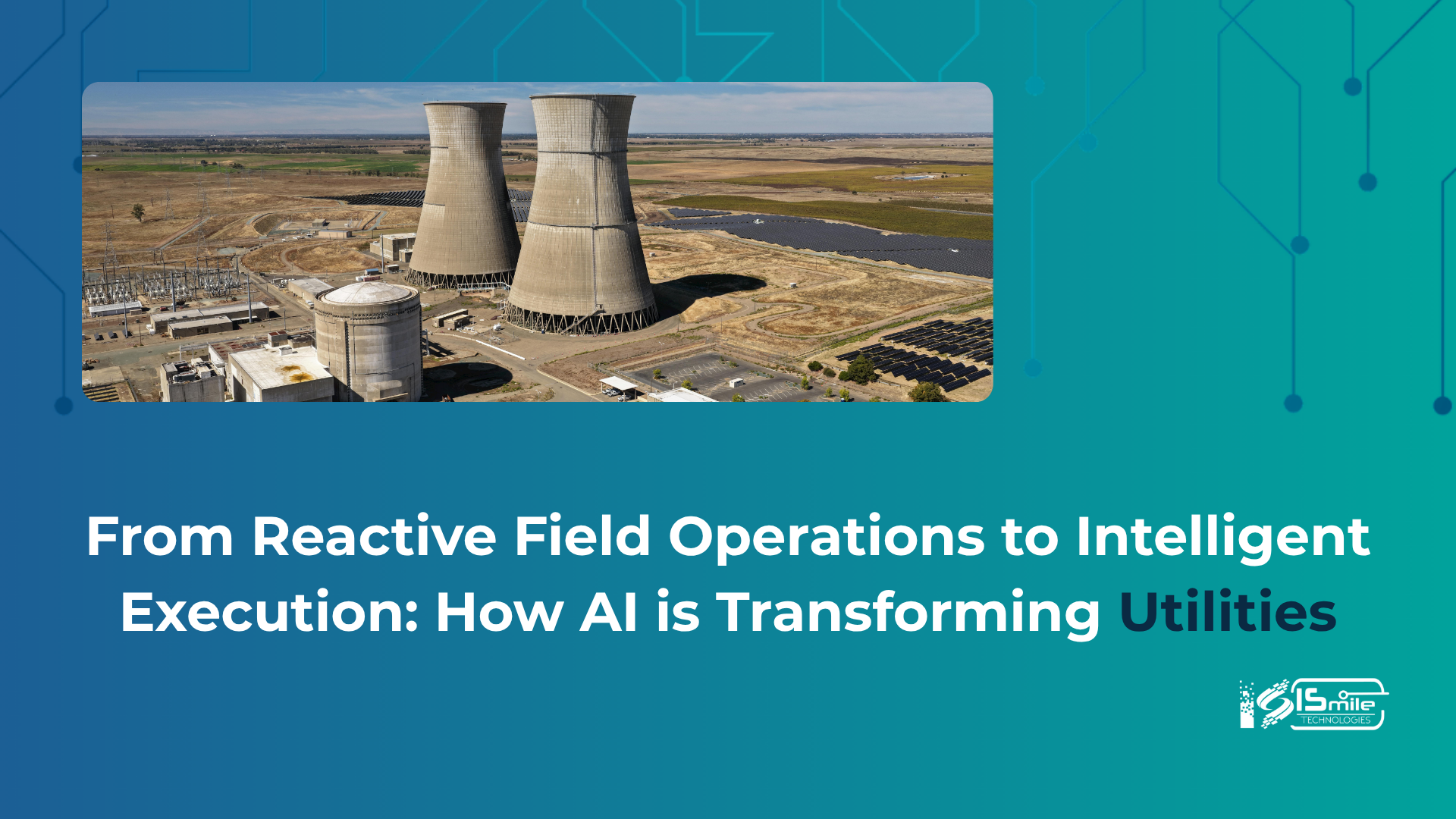

Utilities are under increasing pressure to modernize field operations while ensuring safety, speed, and reliability in real-time environments.
As infrastructure becomes more complex and service expectations rise, traditional field operations—often dependent on manual processes and fragmented systems—are no longer sufficient. The challenge is not just operational efficiency, but enabling teams to make faster, more informed decisions in dynamic, high-risk conditions.
This is where the shift toward intelligent, AI-enabled field operations is redefining how utilities operate.
The Shift to Intelligent Field Operations
Field service is no longer just about executing tasks—it is becoming a decision-centric function powered by data, connectivity, and AI.
Modern utilities are moving toward:
- Context-aware operational intelligence embedded within field workflows
- AI-driven decision support systems that enhance on-ground execution
- Connected ecosystems integrating data across assets, systems, and environments
This transformation enables field teams to operate with greater clarity, responsiveness, and confidence—without relying solely on manual intervention or disconnected tools.
From Data Silos to Real-Time Operational Intelligence
One of the biggest barriers in field operations is the fragmentation of critical data across multiple systems—asset management, GIS, outage systems, and IoT platforms.
AI is changing this by enabling:
- Knowledge augmentation across systems, bringing together structured and unstructured data
- Real-time decisioning, where insights are generated and applied instantly
- Workflow orchestration, ensuring that data triggers the right actions at the right time
Instead of searching for information, field operations evolve into environments where relevant insights surface automatically within the flow of work.
AI + IoT + Edge: Building Connected Utility Operations
A key enabler of this transformation is the convergence of AI with IoT and edge computing.
Utilities are increasingly leveraging:
- IoT-enabled assets that continuously stream operational data
- Edge computing to process data closer to the source for faster response
- AI models that interpret data and support decision-making in real time
This combination allows utilities to move beyond reactive maintenance toward:
- Predictive and condition-based maintenance
- Real-time grid monitoring and optimization
- Improved asset lifecycle intelligence
The result is a more resilient, adaptive, and efficient operational environment.
The Role of Generative AI in Field Operations
Generative AI is introducing a new layer of intelligence in how field operations consume and interact with information.
Instead of static dashboards or manual queries, teams can:
- Interact with systems using natural language
- Access contextual insights derived from multiple data sources
- Generate operational summaries and reports dynamically
This reduces the cognitive load on field teams and enables faster interpretation of complex scenarios—especially in high-pressure environments.
Human + AI Collaboration in the Field Workforce
The future of field operations is not about replacing human expertise—it’s about augmenting it.
AI enhances the workforce by:
- Supporting decision-making with contextual insights
- Reducing manual administrative effort
- Enabling faster onboarding and skill development
At the same time, human judgment remains critical for handling exceptions, ensuring safety, and making strategic decisions.
This creates a collaborative model, where AI handles data-intensive tasks while field teams focus on execution and problem-solving.
Expanding Beyond Field Execution: Enterprise-Level Impact
The impact of AI in utilities extends beyond field teams into broader enterprise operations:
Grid Operations Optimization
AI-driven insights help utilities balance supply and demand, detect anomalies, and improve grid stability in real time.
Predictive Maintenance
By analyzing asset performance data, utilities can anticipate failures and optimize maintenance schedules—reducing downtime and extending asset life.
Asset Lifecycle Intelligence
AI enables better planning, utilization, and replacement strategies for critical infrastructure, improving long-term operational efficiency.
This elevates AI from a tactical tool to a strategic capability across the enterprise.
How ISmile Technologies Enables AI-Powered Field Service Transformation
At ISmile Technologies, we help utilities operationalize AI across field and enterprise systems through a scalable, integrated approach.
Azure + AI + IoT Ecosystem
We leverage Microsoft Azure to build secure, scalable environments that integrate AI, IoT, and enterprise data systems.
Embedded Intelligence in Workflows
Our approach focuses on embedding AI directly into operational processes—ensuring insights are actionable and aligned with real-world scenarios.
Seamless Enterprise Integration
We integrate AI capabilities with existing systems such as asset management, GIS, ERP, and operational platforms—minimizing disruption while maximizing value.
Governance & Security Frameworks
We establish strong governance models to ensure data quality, compliance, and responsible AI usage across the organization.
Industry-Specific Solutions
Our solutions are tailored to utility workflows, addressing challenges in grid operations, maintenance, and field service execution.
Strategic Approach to AI Adoption in Field Operations
To successfully transition toward intelligent field operations, utilities should focus on key transformation pillars:
- Enterprise Readiness: Align data, systems, and governance frameworks
- Use Case Prioritization: Focus on high-impact operational scenarios
- Integrated Architecture: Build connected ecosystems across data and applications
- Scalable Deployment: Ensure solutions can expand across teams and regions
- Continuous Optimization: Improve models and workflows based on real-world feedback
This approach ensures that AI adoption is sustainable, scalable, and aligned with business objectives.
Business Outcomes: From Efficiency to Intelligence
Utilities adopting AI-driven field service transformation can achieve:
- Improved operational efficiency across field and grid operations
- Faster issue resolution and reduced service disruptions
- Enhanced workforce productivity and safety
- Better asset utilization and lifecycle management
- Stronger customer experience through responsive service delivery
More importantly, organizations gain the ability to adapt and respond in real time, which is critical in today’s evolving utility landscape.
Conclusion: The Future of Intelligent Field Operations
The future of field service lies in intelligent, connected operations where AI augments every decision, improving safety, efficiency, and scalability across the enterprise.
Utilities that embrace this transformation will move beyond reactive operations toward predictive, adaptive, and autonomous systems.
With ISmile Technologies as a strategic partner, organizations can accelerate this journey—building AI-powered field operations that are secure, scalable, and ready for the future.

 English
 Indian English