
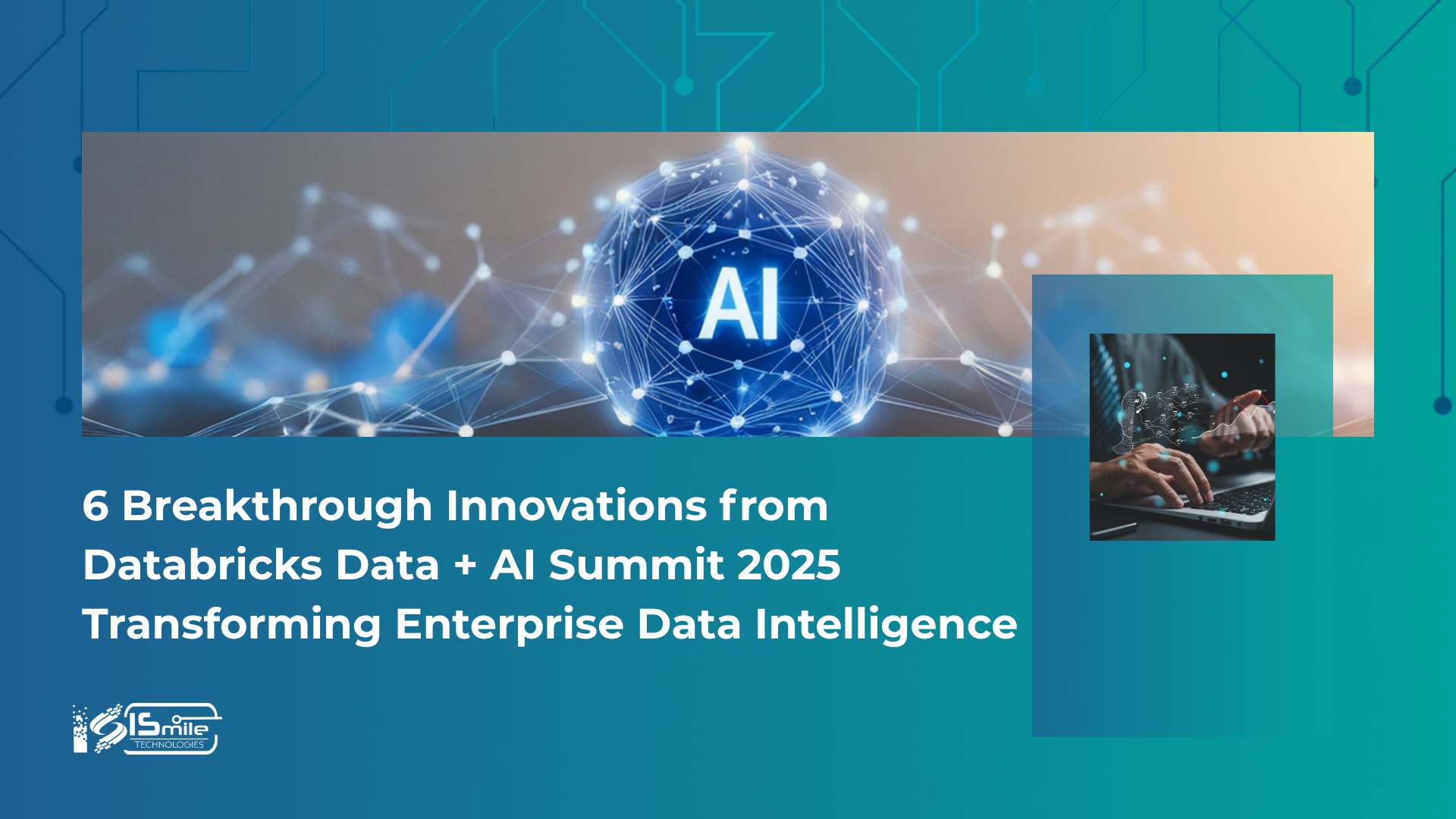

From Data Platforms to Decision Intelligence
The conversation around data is changing.
Enterprises are no longer asking how to store or process data—they’re asking how to turn data into real-time decisions and measurable business outcomes.
At the Databricks Data + AI Summit 2025, this shift was unmistakable. The focus has moved beyond tools and platforms toward building intelligent systems that unify data, AI, and applications.
For organizations, the real opportunity lies not in adopting these innovations—but in operationalizing them at scale.
Here are six key advancements that are redefining how enterprises build AI-driven data ecosystems.
1. Agent Bricks: Accelerating AI-Driven Workflows
One of the most impactful announcements was Agent Bricks—a capability that simplifies how organizations build intelligent AI agents.
Instead of complex development cycles, teams can now define business tasks at a high level and connect enterprise data to create AI agents that:
- Automate workflows
- Extract and process information
- Support decision-making across functions
Why This Matters
This marks a shift toward AI as an operational layer, where intelligent agents actively participate in business processes—not just support them.
For enterprises, this means faster automation, reduced dependency on manual processes, and quicker time-to-value from AI.
2. Lakebase: Operational Data Meets AI
Lakebase introduces a modern, AI-ready database approach designed to bridge the gap between transactional systems and analytics.
It enables:
- Real-time data access for applications
- Seamless integration with analytics and AI workloads
- Scalable, developer-friendly environments
Why This Matters
Organizations can now move from data storage to real-time data activation, enabling applications that respond instantly to business events.
3. Lakeflow: Simplifying the Data Engineering Lifecycle
Data engineering has long been fragmented across multiple tools and pipelines.
Lakeflow addresses this by creating a unified data engineering layer that handles:
- Data ingestion
- Transformation
- Orchestration
Why This Matters
This reduces complexity and enables organizations to build reliable, scalable data pipelines that support real-time analytics and AI.
4. Lakebridge: Fast-Tracking Modernization
Legacy systems continue to slow down innovation.
Lakebridge provides an automated approach to migrating from traditional data warehouses to modern platforms, reducing manual effort and accelerating transformation.
Why This Matters
Enterprises can modernize faster without disrupting operations—unlocking innovation while minimizing risk.
5. SQL Serverless: High Performance, Lower Complexity
Databricks continues to enhance SQL Serverless, enabling high-speed analytics without infrastructure management.
Why This Matters
This democratizes data access—allowing business users, analysts, and engineers to work with data efficiently without worrying about performance or cost trade-offs.
6. Databricks Apps: From Insights to Action
Databricks Apps enables organizations to build and deploy data-driven applications directly within a governed environment.
Teams can:
- Develop interactive applications
- Integrate with existing workflows
- Ensure security and compliance
Why This Matters
This closes the gap between insights and execution, enabling organizations to turn data into real business actions.
The Bigger Shift: Data + AI + Applications Converge
What ties these innovations together is a larger transformation:
The convergence of data platforms, AI capabilities, and business applications into a single ecosystem.
This is where organizations move from:
- Dashboards → Decision systems
- Data pipelines → Intelligent workflows
- Insights → Automated actions
The Role of GenAI in Modern Data Intelligence (Key Differentiator)
A defining trend across these innovations is the rise of Generative AI within data platforms.
GenAI enables:
- Natural language interaction with data
- Faster development of data applications
- AI-assisted analytics and decision-making
This creates a self-service data environment, where business users can access insights without deep technical expertise.
How ISmile Technologies Helps Enterprises Turn Innovation into Outcomes
While these advancements are powerful, the real challenge lies in implementation and adoption.
ISmile Technologies helps organizations bridge this gap by combining cloud, data, and AI expertise with real-world execution.
Our Approach Includes:
- Modern Data Platform Implementation
Building scalable, cloud-native architectures for unified data and AI - AI Integration into Business Workflows
Embedding AI into real processes—not just dashboards - Migration & Modernization
Moving from legacy systems to modern platforms with minimal disruption - Governance & Security
Ensuring compliance, data quality, and trust across systems - Microsoft + Databricks Ecosystem Expertise
Leveraging Azure, Fabric, and Databricks together for maximum impact
Real-World Enterprise Scenarios
Financial Services
A bank modernizes its data platform and deploys AI-driven analytics to detect fraud in real time.
Outcome: Faster detection, reduced risk, and improved compliance.
Healthcare & Pharma
A life sciences organization integrates research and clinical data into a unified platform.
Outcome: Accelerated insights and improved decision-making in drug development.
Retail & E-commerce
A retailer builds AI-driven demand forecasting and customer analytics applications.
Outcome: Better inventory planning and improved customer engagement.
Conclusion
The innovations unveiled at Databricks Data + AI Summit 2025 are not just product enhancements—they represent a fundamental shift toward intelligent, AI-driven enterprises.
But technology alone is not enough.
Success depends on how effectively organizations can:
- Integrate these capabilities
- Align them with business goals
- Scale them across the enterprise
With ISmile Technologies as a strategic partner, enterprises can move beyond adoption and build data intelligence systems that deliver measurable business outcomes.
Frequently Asked Questions (FAQs)
1. What was the key theme of Databricks Data + AI Summit 2025?
The convergence of data, AI, and applications into unified platforms that enable real-time decision-making.
2. What is Agent Bricks?
It is a capability that enables organizations to build AI agents quickly by defining tasks and connecting enterprise data.
3. How does Lakeflow improve data engineering?
It unifies data ingestion, transformation, and orchestration into a single platform, reducing complexity.
4. What is the benefit of SQL Serverless?
It provides high-performance analytics without requiring infrastructure management.
5. How do Databricks Apps help businesses?
They enable organizations to build and deploy data-driven applications that turn insights into actions.
6. What role does GenAI play in data intelligence?
GenAI enables natural language interaction, faster development, and AI-assisted analytics.
7. Why is data modernization important?
Legacy systems limit scalability and innovation, making modernization essential for AI adoption.
8. How can organizations implement these innovations?
By adopting modern data platforms, integrating AI into workflows, and ensuring governance and scalability.
9. How does ISmile Technologies support Databricks adoption?
ISmile Technologies provides end-to-end services, including platform implementation, AI integration, and modernization.
10. What outcomes can enterprises expect?
Faster decision-making, improved efficiency, reduced costs, and enhanced innovation.


 English
 Indian English